
Image for illustrative purposes only
Sensura Mio Click Skin Barrier Concave Cut-to-size | CP-18500
SenSura® Mio Click Skin Barrier — Concave, cut-to-fit, 40mm coupling
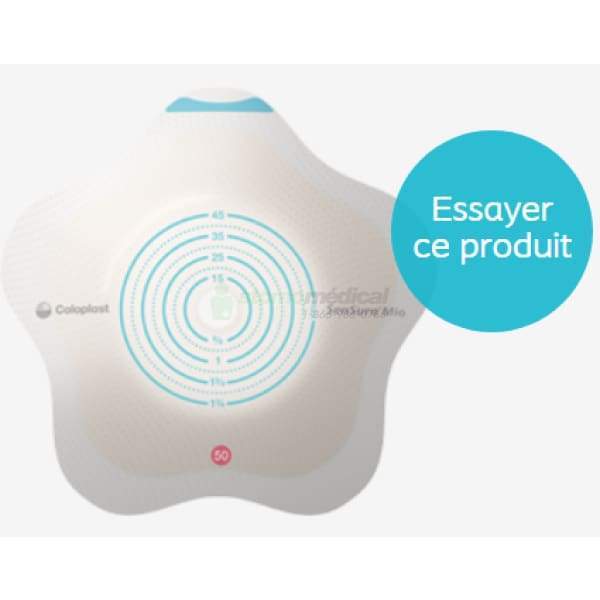
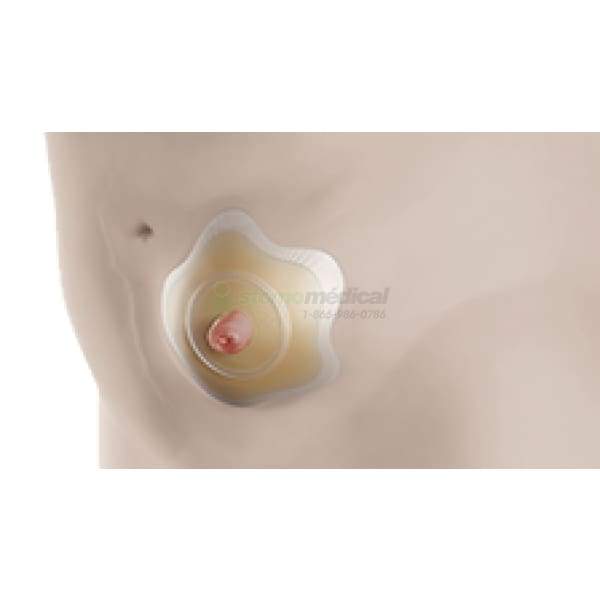
The Coloplast SenSura® Mio Click Concave skin barrier, manufacturer reference 18500, is particularly well-suited to bulges, curves and peristomal hernias. The star-shaped flange contour hugs the hernia without creating folds, while the central ring stabilizes the area around the stoma to provide the necessary support. This cut-to-fit barrier offers a 40mm (1-9/16in) coupling, with a cutting range of 10mm to 35mm (3/8in to 1-3/8in).
Key Features
- Concave star shape, hugs bulges, hernias and folds without creating tension
- Central stabilizing ring, providing needed support around the stoma
- Coupling: 40mm (1-9/16in)
- Cut-to-fit, 10mm to 35mm (3/8in to 1-3/8in)
- Box of 5
Technical Specifications
| Manufacturer | Coloplast |
| Brand | SenSura® Mio Click |
| Manufacturer reference | 18500 |
| Stomo Médical SKU | CP-18500 |
| Type | Two-piece skin barrier, concave, cut-to-fit |
| Coupling | 40mm (1-9/16in) |
| Cutting range | 10mm to 35mm (3/8in to 1-3/8in) |
| Quantity | Box of 5 |
Other couplings in the same Concave cut-to-fit line: 50mm, range 10-45mm (ref. 18510); 60mm, range 10-55mm (ref. 18520); 70mm, range 10-65mm (ref. 18530). A pre-cut version, 60mm coupling/45-55mm, is also sold separately (ref. 18524).
Usage Indications
This concave skin barrier is intended for people with bulges, peristomal hernias or marked folds around the stoma, difficult to manage with a standard flat or convex barrier. Its star shape hugs the irregular skin contour while maintaining central support around the stoma. The cut-to-fit format allows precise adjustment of the opening to stoma size, between 10mm and 35mm.
Frequently Asked Questions
What distinguishes a concave barrier from a convex one?
A convex barrier pushes peristomal skin inward to help a retracted stoma protrude, while a concave barrier hugs bulges and hernias by following their contour without exerting excessive central pressure.
What is the exact cutting range for this barrier?
The flange can be cut between 10mm and 35mm (3/8in to 1-3/8in) in diameter.